Mercury retrograde: what it really means (and what it doesn't)
Few astrology phrases have escaped into everyday life like 'Mercury retrograde.' People blame it for missed flights, garbled emails, and phones that pick the worst moment to die. Some of that is fun, some of it is overblown, and almost none of it gets the basics right. So let's clear it up as friends would over coffee: what retrograde actually is, why Mercury in particular gets singled out, and what's genuinely worth doing — and not doing — during the few weeks it runs, which happens three or four times a year.
What 'retrograde' actually means
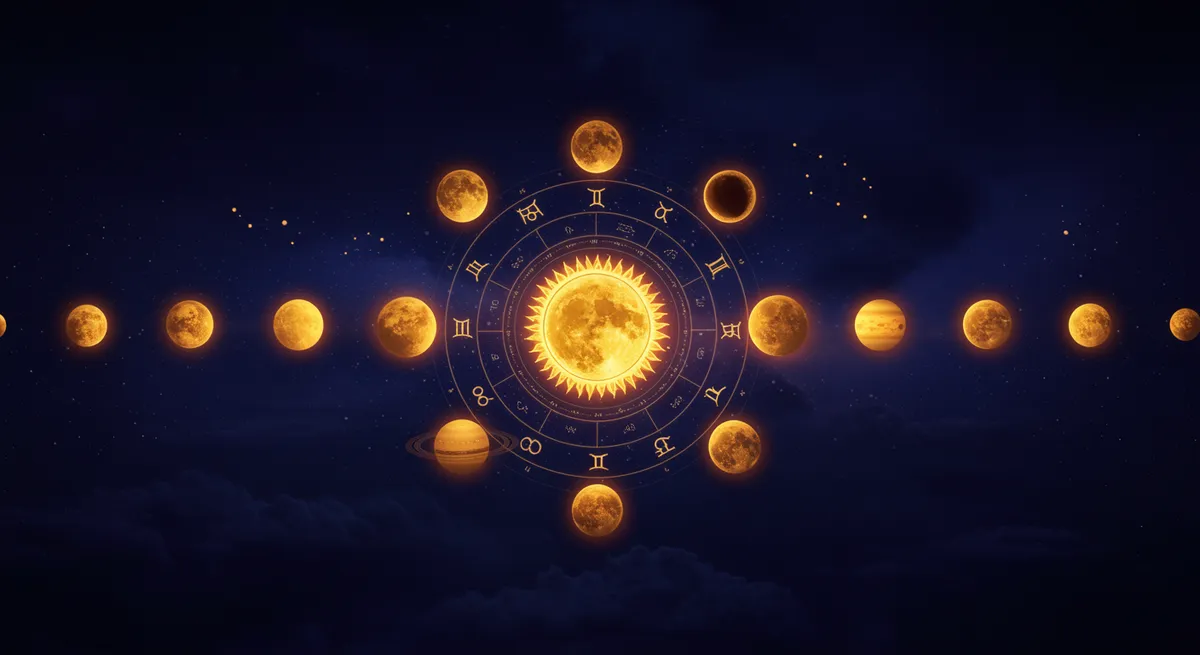
Here's the thing that surprises most people: planets never truly move backward. Retrograde is an optical illusion. Every planet orbits the sun in the same direction, but they travel at different speeds. Mercury is the closest planet to the sun and the fastest, so a few times a year it overtakes Earth on the inside, a bit like a fast car passing a slower one on a racetrack. As Mercury zips past us, it briefly appears — from our moving vantage point — to slow down, stop, and drift backward against the background stars before resuming its forward path. Astronomers call this 'apparent retrograde motion.' Nothing in space has reversed; it's a trick of perspective, the same way a slower car next to you can look like it's rolling backward when you accelerate past it.
Why Mercury rules communication, tech, and travel
In astrology, every planet is associated with a set of life themes, and Mercury has always been the planet of the mind in motion. It governs communication, thinking, language, learning, short trips, and the exchange of information — and in the modern world, that umbrella naturally stretches to cover phones, email, software, contracts, and travel logistics, since all of those are really just information moving from one place to another. So when astrologers say Mercury is the planet 'retrograding,' the symbolism is about those domains. The idea isn't that the sky breaks your laptop; it's that this is a season for reviewing, double-checking, and slowing down in exactly the areas Mercury represents.
Sensible do's and don'ts
Treated reasonably, Mercury retrograde is less a curse and more a nudge toward care. The traditional advice clusters around the prefix 're-': review, revise, reflect, reconnect, redo. Good fits for the period: backing up your files, proofreading before you hit send, double-confirming travel times and bookings, finishing half-done projects, and reaching out to people you've lost touch with. The classic 'avoid' list — signing major contracts, buying expensive electronics, launching something brand new — is best read as 'don't rush these; build in extra checking time,' not 'never do them.' Life doesn't pause for three weeks. If you must sign a lease during a retrograde, you simply read it twice and ask the question you'd otherwise skip.
It also helps to know about the 'shadow' periods on either side of the retrograde — the days just before Mercury appears to turn back and just after it resumes forward motion, when many people report a similar slowed-down, things-need-rechecking feeling. You don't have to track those windows obsessively. The takeaway is simply that the effect, if you notice one at all, fades in and out rather than flipping on and off like a switch, so there's no exact midnight where you're suddenly 'safe' again. Build your good habits to last a few weeks rather than a single dramatic day, and you've covered it.
Debunking the panic
It's worth saying plainly: Mercury retrograde is not a documented cause of accidents, breakups, or technology failing, and there's no need to put your life on hold for it. Phones break and emails get misread every week of the year. What retrograde can usefully do is act as a built-in reminder to be more deliberate — a recurring cue to slow down and check your work. The healthiest way to use it is as a prompt for good habits you should have anyway, not as a source of dread. If a forecast ever leaves you feeling helpless or doomed, that's a sign to step back; astrology at its best hands you more awareness, not less control.
A worked example
Take Daniel, who's about to email a big project proposal to a new client right as Mercury stations retrograde. The fearful version of astrology would tell him the deal is cursed and he should hide until it's over. The sensible version does something more useful: it flags this as a Mercury-themed window — communication and contracts — and suggests he treat it as a review period. So Daniel reads the proposal one extra time and catches that he'd written the wrong delivery date. He confirms the client's preferred contact method instead of assuming. He saves a copy before sending. He sends it anyway, on time, just with more care than usual — and the deal goes fine. Notice what happened: the retrograde didn't sabotage him, and it didn't save him either. It simply nudged him into the double-checking that good professionals do regardless, and that small extra attention is the whole practical value of the period.
Frequently asked questions
How often does Mercury retrograde happen, and how long does it last? Mercury goes retrograde three to four times a year, and each stretch lasts roughly three weeks. Because it's so frequent, it's never worth treating as a rare emergency — it's a recurring season, more like a quarterly reminder to slow down than a once-in-a-blue-moon event.
Should I really avoid signing contracts or buying a phone? You don't have to avoid them, but it's a fine time to be extra careful. The spirit of the advice is to add a layer of checking — read the fine print twice, confirm the warranty, test the device before you leave the store. If the timing is forced by real life, proceed thoughtfully rather than superstitiously.
Why does it feel like everything goes wrong during Mercury retrograde? A lot of it is confirmation bias: once you've been told to expect mishaps, you notice and remember every lost text and traffic jam, while ignoring the smooth days. Communication hiccups happen all year round. Retrograde gives them a label, which makes them feel concentrated even when they aren't.
Is Mercury retrograde a good time for anything? Absolutely — it's well suited to anything starting with 're-'. Reviewing past work, revising a draft, reorganising your files, reconnecting with old friends, and reflecting on a decision all fit the energy beautifully. If you've been meaning to tidy up loose ends, this is a natural window for it. LuckMap can show you when the next Mercury retrograde falls and what it touches in your own chart, so you can plan the careful tasks rather than worry about them.