
Raj yogas and other yogas in your chart
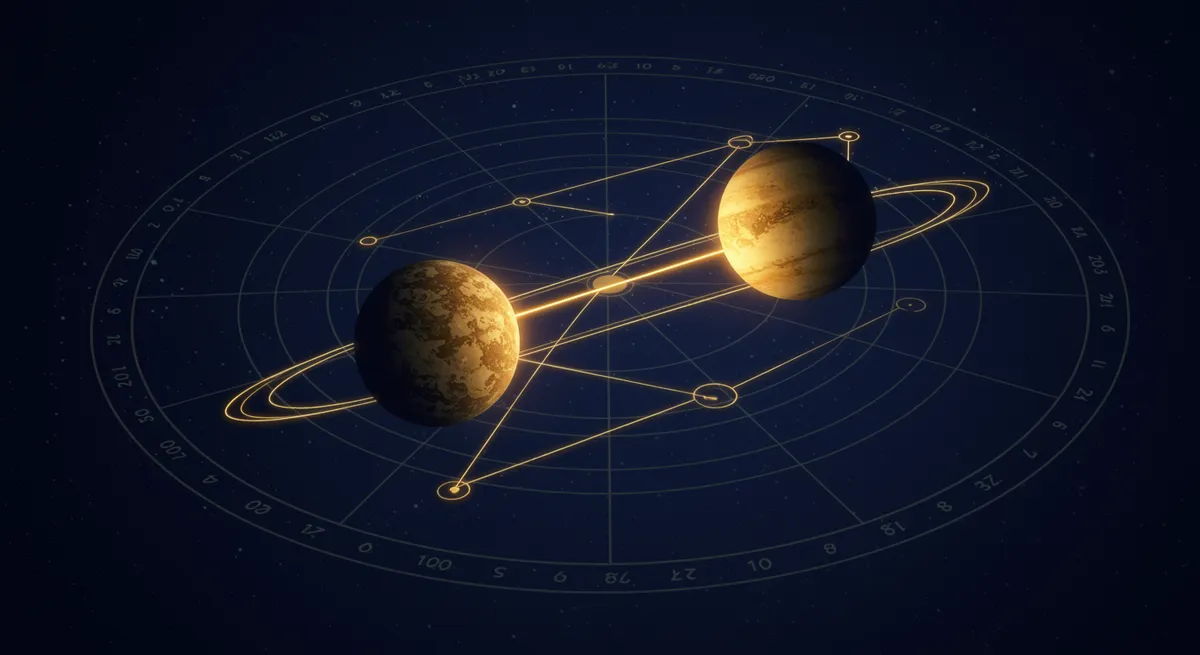
Open a Vedic chart reading and you'll often see the word yoga thrown around with excitement: 'You have a powerful Raj yoga!' It sounds dramatic, and it's one of the most misunderstood ideas in astrology. A yoga, in this context, has nothing to do with stretching or breathing — the Sanskrit word simply means 'union' or 'combination'. In chart terms, a yoga is a specific arrangement of planets that, when it appears, is said to produce a particular kind of result. Some yogas suggest success and ease; others suggest struggle. Learning to read them is less about hunting for one magic combination and more about understanding how planets team up. Let's walk through the most talked-about ones and, just as importantly, the big caveat that keeps them honest.
What a yoga actually is
A yoga is a defined pattern — a rule that says 'if these planets relate to each other in this way, expect this flavour of result.' The relationship can be a conjunction (two planets sitting together in the same sign), a mutual aspect (planets looking at each other across the chart), an exchange of signs (two planets sitting in each other's home signs), or a planet occupying a particular kind of house. There are hundreds of named yogas in the classical texts. Most charts contain several at once — good ones and challenging ones mixed together — which is exactly why no single yoga tells the whole story.
Raj yoga
Raj yoga literally means 'royal combination', and it's the one everyone wants to hear about. To understand it you need two house-categories. Kendras are the four 'angular' houses (the 1st, 4th, 7th, and 10th) — the pillars of a chart, tied to self, home, partnership, and career. Trikonas are the 'trine' houses (the 1st, 5th, and 9th) — tied to fortune, creativity, and dharma or life-purpose. A classic Raj yoga forms when the lord (ruling planet) of a kendra and the lord of a trikona come together — by conjunction, aspect, or exchange. The idea is that the chart's pillars and its luck-houses are cooperating, which can support rise in status, authority, and achievement. It's genuinely auspicious — but note the word 'support', not 'guarantee'.
Gajakesari yoga
Gajakesari is one of the prettiest-sounding yogas — the name evokes an elephant (gaja) and a lion (kesari), strength and dignity together. It forms when Jupiter (wisdom, expansion, good judgement) sits in a kendra — a 1st, 4th, 7th, or 10th house — counted from the Moon (the mind and emotional nature). When the planet of wisdom anchors one of the chart's pillars relative to your mind, it's read as a sign of intelligence, good character, respect from others, and steadiness under pressure. It's common enough that plenty of people have it, which is a useful reminder: a yoga being present matters far less than how strong and clean it is.
Dhana yogas
Dhana means 'wealth', so Dhana yogas are combinations associated with the capacity to earn and accumulate. They typically involve cooperation between the money-houses — chiefly the 2nd house (savings, family wealth, what you hold) and the 11th house (gains, income, networks) — often with the 5th and 9th (the fortune houses) joining in. When the lords of these houses connect, the chart is read as having a built-in channel for wealth to flow and stay. As always, the channel still has to be switched on by a supportive Dasha (planetary period) and watered by real-world effort — the yoga describes potential plumbing, not a guaranteed bank balance.
Neecha Bhanga: the cancelled weakness
This one is a favourite because it's a story of redemption. 'Neecha' means debilitated — a planet sitting in the sign where it's at its weakest, struggling to deliver. 'Bhanga' means cancellation or breaking. Neecha Bhanga Raja Yoga is a set of conditions under which that weakness gets cancelled — and sometimes flips into unusual strength. The classic signs include the planet that rules the debilitation sign being well-placed, or the planet that would be exalted in that same sign sitting in a strong angle. The human meaning is lovely: a placement that looks like a clear handicap on paper can, under the right support, become a source of late-blooming success — the person who started from a disadvantage and rose anyway.
A worked example
Picture a chart where the 9th house (fortune, the trikona of luck) is ruled by Jupiter, and the 10th house (career, a kendra pillar) is ruled by Saturn — and these two planets sit together in one sign, looking out at the chart side by side. A trikona lord and a kendra lord in conjunction is a textbook Raj yoga. On paper, promising: fortune and career are pulling in the same direction. But before declaring this person destined for the top, you'd check the fine print. Are Jupiter and Saturn strong in their signs, or weak? Is the house they sit in a helpful one or a difficult one (like the 6th, 8th, or 12th, the trickier houses)? And is a Dasha running that actually activates these planets — because a brilliant yoga sitting dormant during an unrelated planetary period may simply wait its turn. The same yoga can read as life-changing in one chart and merely pleasant in another, depending entirely on this context.
The big caveat: one yoga isn't a life
Here's the part that gets lost in the excitement. Almost every chart has impressive-sounding yogas in it — and almost every chart has difficult ones too. A real reading weighs the whole picture: the strength of the planets involved, the houses they fall in, the Dasha timing, and how the yogas balance against each other. Hearing 'you have a Raj yoga' tells you a promising thread exists; it does not tell you your life is set. Treat yogas as guidance about tendencies and potentials, never as a fixed prediction of fame, riches, or fate. The chart leans; you and your circumstances still steer.
Frequently asked questions
If I have a Raj yoga, does that mean I'll be rich or powerful? Not on its own. A Raj yoga points to supportive potential for rise and status, but its real effect depends on how strong the planets are, which houses are involved, and whether a Dasha activates it during your life. It's a favourable tendency, not a promise.
Can a chart have good and bad yogas at the same time? Yes — almost all do. Charts are mixtures. The skill in reading is weighing how strong each combination is and how the supportive and challenging ones balance, rather than seizing on one and ignoring the rest.
Why do astrologers disagree about which yogas I have? Because many yogas have strict classical conditions, and small differences in technique — which house system or rules an astrologer follows, and how precise your birth time is — can change whether a yoga is judged 'fully formed'. A borderline yoga may count for one reader and not another.
Is Neecha Bhanga really a good thing if a planet is debilitated? It can be. The cancellation conditions are specific, and when they're genuinely met, a weak-looking planet can perform far better than expected — sometimes producing notable success. But the conditions have to actually be satisfied; the mere presence of a debilitated planet does not automatically mean its weakness is cancelled.
You can see which yogas appear in your own chart, and how strong they are, in the Vedic section of LuckMap — and ask for a grounded, non-hyped explanation of what each one means for you.