Dashas: how Vedic astrology predicts timing
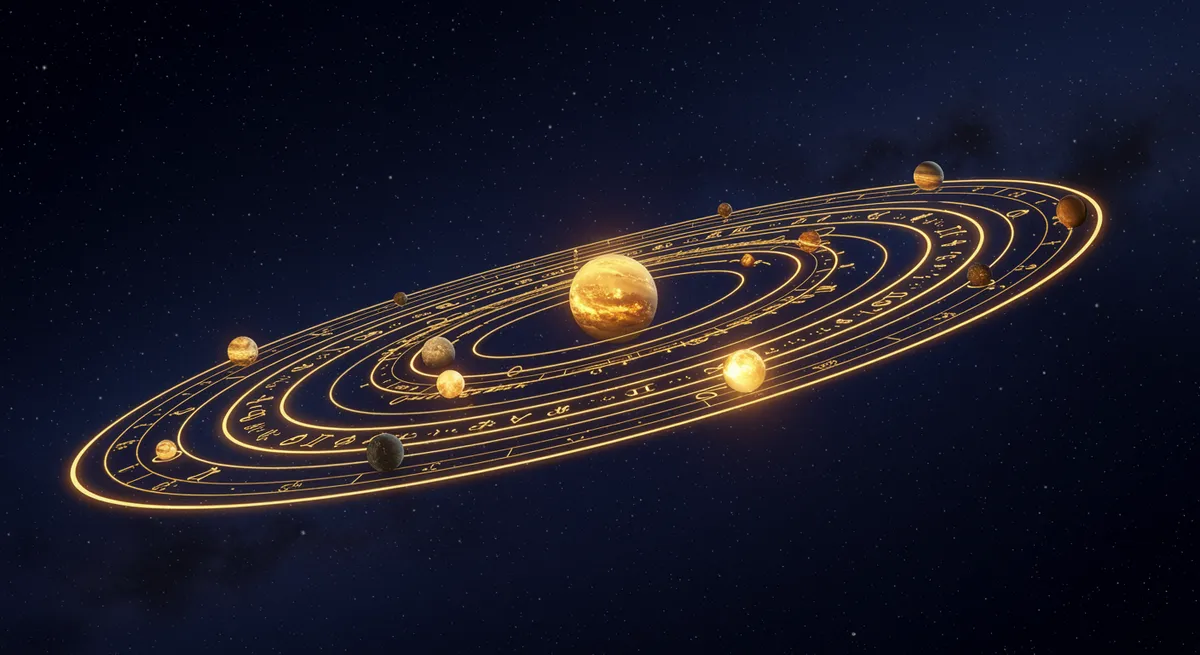
Two people can have almost the same birth chart and still live very different decades — one of them thriving while the other waits and struggles. The reason is timing. A Vedic birth chart (your kundli, the map of where the planets sat when you were born) shows what you're capable of, but it's a still photograph. The Dasha system is what turns that photograph into a film. A Dasha is simply a planetary period — a stretch of years that belongs to one planet, during which that planet 'runs the show' and switches on the parts of your chart it controls. The most widely used version is the Vimshottari Dasha, and once you understand it, a lot of Vedic timing stops feeling mysterious.
What Vimshottari means
Vimshottari is Sanskrit for 120 — the total number of years the full cycle covers. The whole sequence is divided among nine planets, each getting a fixed slice of those 120 years. The order never changes and the lengths never change; what differs from person to person is where in the cycle you were born. So the system isn't random — it's a fixed wheel, and your birth simply sets where the needle starts. Everyone is somewhere on the same 120-year wheel, just at a different point.
The nine periods and their lengths
Here are the nine planetary periods (the maha or 'great' periods) and how many years each lasts. Ketu — 7 years. Venus — 20 years. Sun — 6 years. Moon — 10 years. Mars — 7 years. Rahu — 18 years. Jupiter — 16 years. Saturn — 19 years. Mercury — 17 years. Add them up and you get exactly 120. The order is always Ketu → Venus → Sun → Moon → Mars → Rahu → Jupiter → Saturn → Mercury, then it loops back to Ketu. Note that the two longest periods belong to Saturn and Rahu, two planets famous for slow, demanding lessons — which is part of why those decades can feel so formative.
How your starting point is set
Your starting Dasha isn't chosen at random and it isn't based on your Sun sign. It's set by the Moon's nakshatra — the lunar mansion, one of 27 small star-segments the sky is divided into, that the Moon occupied at your birth. Each nakshatra is ruled by one of the nine planets, and that ruler becomes your first Dasha lord. How far the Moon had already travelled through that nakshatra decides how much of that first period was already 'used up' before you were born. That's why your very first Dasha is usually a partial one, and the full periods follow in order after it.
Mahadasha versus antardasha
A single planetary period can last up to twenty years, which is far too broad to time real events. So each Dasha is subdivided. The big period is the mahadasha (maha = great) — the overall chapter you're living. Inside it run smaller sub-periods called antardashas (also called bhuktis), each belonging to one of the nine planets in the same fixed order. Think of it as two hands on a clock. The mahadasha is the slow hand that sets the mood of a whole life-chapter; the antardasha is the faster hand that colours the months and few-year stretches within it. Astrologers read both together: the result of any moment is a blend of the mahadasha lord and the antardasha lord. There are even finer levels below this (pratyantardasha and deeper) for pinpointing shorter windows.
How a Dasha colours a life phase
When a planet's period begins, it activates the houses (the twelve life-departments of the chart) that the planet rules and sits in, and the planets it sits with or aspects. A benefic, well-placed planet running its period tends to deliver its good results during those years — that's when the chart's promise tends to ripen. A planet that is weak or poorly placed can make its period feel like wading through mud. The same chart can feel like a golden run during one Dasha and a long slog during another. Crucially, this is guidance about the texture and timing of a phase, not a fixed verdict — a so-called difficult period often turns out to be the one that forces real growth, and your own choices still shape how it plays out.
A worked example
Imagine someone whose Jupiter is strong and well-placed, sitting in a house connected to career and learning. Jupiter is the planet of wisdom, expansion, and opportunity. When this person enters their 16-year Jupiter mahadasha, the years tend to open up — study, teaching, mentors, growth, a sense of luck. Now zoom into the sub-periods. Early in that Jupiter mahadasha runs the Jupiter–Saturn antardasha: Saturn is discipline and hard, patient work, so this window might feel like serious, grounded effort — building something real but slowly. Later comes the Jupiter–Venus antardasha: Venus governs relationships, comfort, and the arts, so that stretch might bring a relationship, a creative phase, or a more pleasurable, sociable patch of life. Same overall chapter (Jupiter's expansion), two very different sub-moods depending on which sub-lord is running. That layering is the whole art of Dasha reading.
Frequently asked questions
Does a good Dasha guarantee good things will happen? No. A Dasha shows which themes get activated and when they're most likely to ripen, but the chart's underlying promise and your own effort both matter. A favourable period makes good outcomes easier to reach; it doesn't hand them over automatically, and a planet's results depend heavily on how it's placed in your particular chart.
Why does my birth time matter so much for Dashas? Because the whole sequence is anchored to the Moon's exact position at birth, and the Moon moves quickly — it changes nakshatra roughly every day and shifts within a nakshatra by the hour. A birth time that's off by even a couple of hours can change how far into your starting Dasha you were born, which shifts the dates of every period that follows.
Is Vimshottari the only Dasha system? No, Vedic astrology has many Dasha systems — Yogini, Ashtottari, and Chara (Jaimini) among them. Vimshottari is by far the most widely used and is usually the default, but experienced astrologers sometimes cross-check timing with a second system.
What happens at the junction between two Dashas? The handover between one mahadasha and the next — sometimes called a sandhi, or junction — is often felt as a period of transition, where the themes of life noticeably shift. It's a natural turning point rather than something to fear; the old chapter winds down and a new planetary tone takes over.
You can look up your own current mahadasha and antardasha, with their exact dates, in the Vedic section of LuckMap — and ask a plain-language question about what the period you're in tends to bring.